 Professor Yang Gao FIET
FRAeS
Professor Yang Gao FIET
FRAeS
· Global STEM Professor, HKUST
· Founding Director of Centre for AI Robotics in Space
Sustainability, HKUST
· Co-Director of Space Science & Technology Institute, HKUST
· Director of InnoHK Hong Kong Space Robotics & Energy Centre
· Editor-in-Chief of Wiley's Journal of Field Robotics
· IEEE-RAS Distinguished Lecturer on Space Robotics
· Mentor of United Nations Space4Women Program
· Deputy Secretary-General of Chinese Society of Space Research
Biography
Awards &
Leadership
Research Expertise
a.
perception & visual GNC
b.
reconfigurable autonomy
c.
bio-inspired mechanism
News & Media
Biography
Joined HKUST since mid-2025, Professor Yang Gao is the the Global STEM Professor,
whereby she founded and
heads the Centre for AI Robotics in Space Sustainability (CAIRSS). Before joining
HKUST, she spent over 20 years in the UK (2004-2025), working at King’s College
London as the Professor of Robotics and Head of Centre for Robotics
Research, before which at University of Surrey as the Professor of Space
Autonomous Systems where she also founded and led the multi-award winning
Space Technology for Autonomous & Robotic systems Laboratory (STAR-LAB ,
est. 2007). Prior to moving to the UK from Singapore in 2004, Prof Gao was an
awardee of the prestigious Singapore Millennium Foundation Postdoctoral
Fellowship working on intelligent and autonomous vehicles. She gained the
B.Eng. (First Class Honors) degree and Ph.D. degree from the Nanyang
Technological University, Singapore in 2000 and 2003 respectively.
 Prof Gao specializes in robotic
sensing, perception, visual GNC and biomimetic mechanisms for space and other industry
applications for extreme environments. She brings over 20 years of
research experience in developing robotics and autonomous systems,
in which she has been the Principal Investigator
of inter/nationally teamed projects funded by UK Research Innovation
(UKRI), Royal Academy of Engineering, European Commission, European Space
Agency (ESA), UK Space Agency (UKSA), Innovation and Technology Commission
(ITC), as well as industries. Prof Gao is actively involved in design and
development of real-world space missions including ESA ExoMars, Proba3 and
VMMO (lunar ice mapper), UK's CLEAR, MoonLITE and Moonraker, and CNSA Chang'e-3
and -8. Her work has also been applied to several non-space sectors
including nuclear, oil/gas and agriculture through technology transfer and
spin-offs.
Prof Gao specializes in robotic
sensing, perception, visual GNC and biomimetic mechanisms for space and other industry
applications for extreme environments. She brings over 20 years of
research experience in developing robotics and autonomous systems,
in which she has been the Principal Investigator
of inter/nationally teamed projects funded by UK Research Innovation
(UKRI), Royal Academy of Engineering, European Commission, European Space
Agency (ESA), UK Space Agency (UKSA), Innovation and Technology Commission
(ITC), as well as industries. Prof Gao is actively involved in design and
development of real-world space missions including ESA ExoMars, Proba3 and
VMMO (lunar ice mapper), UK's CLEAR, MoonLITE and Moonraker, and CNSA Chang'e-3
and -8. Her work has also been applied to several non-space sectors
including nuclear, oil/gas and agriculture through technology transfer and
spin-offs.
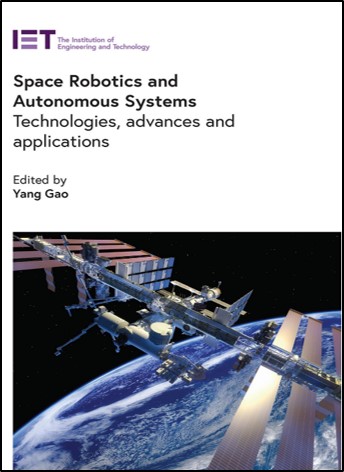
Prof Gao has edited
and co-authored 4 books, including 2 textbooks by Wiley-VCH and IET, 1 research book by McGraw-Hill, and 1 proceeding book
by Springer.
She also co-authored over 180 scientific papers in
internationally refereed books, journals and conference proceedings.
Awards & Leadership
Prof Gao is the elected Fellow of Institute of Engineering
and Technology (IET) and Royal Aeronautical Society (RAeS). She had been named
by the Times Higher Education
top ten young leading academics in the UK who are making a very significant
contribution to their disciplines in 2008, received the Mulan Award for Contributions to
Science, Technology and Engineering in 2019, and Distinguished
Global Leadership Award in 2025 and White Page’s Global Women Power Leaders (2026).
Research work under her leadership and supervision has received many international
recognition, including IAF 3AF Edmond Brun Silver Medal in 2013,
COSPAR Outstanding Paper Award in
2016, UKSEDS Lunar Rover Competition First Prize in 2017, Winner of
ESA SysNova Challenge on Lunar CubeSat Exploration
in 2018, IEEE/ASME-AIM Best Paper Award Finalist
in 2019, Top 3 in ESA/Stanford Pose Estimation Challenge in
2019, First Prize of Wiley Poster Award at IEEE-ICRA Space Workshop in
2020, and First Prize of 14th Sino-UK Entrepreneurship Competition
2022, among others.
Prof Gao is the Editor-in-Chief of Wiley Journal of Field
Robotics, the Section
Editor, Associate Editor or Guest Editor of other
international journals such as Springer's Current Robotics Reports, Frontiers'
Robotics and AI, IEEE-CIM, and IEEE-AESM, and the Chair/Co-Chair/Member of
technical committees such as IMechE Engage in Space Committee, IEEE-CIS Task
Force and IEEE-RAS Technical
Committee on Space Robotics.
Prof Gao serves major funding
review panels or committees for UKRI Future Leadership Fellowship,
European Science Foundation, and Royal Society International Fellowship, etc.
She is also the Mentor for the Mulan Foundation as well as the United Nations Office
for Outer Space Affairs (UNOOSA) Space4Women
program.
Prof Gao was the Conference General Chair
of TAROS-2017 (the longest running UK-hosted international
conference on AI robotics), the Conference
Co-Chair of Light Conference 2018, the Conference
Co-Chair of IEEE/ASME International Conference on Advanced
Intelligent Mechatronics (AIM-2019) and International Conference of Space
Robotics (iSpaRo 2024 and 2025), and the Keynotes or Invited Speaker of
conferences and events (such as ESA/UKSA/RAeS Space Energy, iSpaRo, ESA
AI-STAR, IEEE-UK/Ireland RAS Prestigious Lecture, IEEE ICRA-Space Workshop,
IEEE-CDC, iSAIRAS, UK Space Conference, World Congress of Robotics,
IET Seminars, UK-RAS International Robotics Showcase, EMSTA Prestige
Seminar, UK Astrobiology and Planetary Exploration Series, RiTA, and so
on).
Prof Gao had been Associate Dean (International) of the
Faculty of Engineering and Physical Sciences at University of Surrey in
2016-2021, leading international agenda and strategic development for the
faculty while heading the faculty international committee and serving the
university global engagement committee.
She currently serves major
leadership roles at HKUST on top of leading her own research team, such as
being the Co-Director of the university-wide Space Science & Technology
Institute as well as the Director of the ITC-funded Hong Kong Space Robotics
& Energy Centre (HKSREC, an InnoHK Centre)
that leads the Hong Kong Operation Robot development within Chang’E 8
mission.
Research Expertise
a) Sensing, Perception & Visual GNC
 This research leads to
low-computation, high-accuracy 3D mapping and perception and GNC for future
spacecraft and astronaut-assistive tasks in next-generation missions, ranging
from formation flying, on-orbit servicing and manufacturing, to planetary exploration
and in-situ resource utilization. Real-time testing and validation have been
carried out using realistic simulators, lab-based testbeds or field trials, see
demo videos at YouTube Playlists for orbital applications and planetary
applications .
This research leads to
low-computation, high-accuracy 3D mapping and perception and GNC for future
spacecraft and astronaut-assistive tasks in next-generation missions, ranging
from formation flying, on-orbit servicing and manufacturing, to planetary exploration
and in-situ resource utilization. Real-time testing and validation have been
carried out using realistic simulators, lab-based testbeds or field trials, see
demo videos at YouTube Playlists for orbital applications and planetary
applications .
Major funded projects and
contributions to real-world space missions: ESA ExoMars mission’s PanCam payload and Phase
A study; ESA Proba3 mission’s FLLS payload; UKSA funded CREST-1, NSTP2, and
CREST-3 projects; Airbus funded OOA project; CNSA Chang’E3 mission’s PanCam
data analytics; UKRI/UKSA funded Future AI & Robotics for Space
(FAIR-SPACE) project; UKSA funded space debris removal mission CLEAR Phase B; ITC funded HKSREC’s Hong Kong Operation Robot project for
Chang’e 8.
Major journal papers and book
chapters: see link
b) Reconfigurable Autonomy
 The research leads to
technologies for domain-independent reconfigurable software architectures for
future autonomous systems or astronaut assistive tasks. It builds on autonomous
software agents with abilities to learn and reason. Such technologies are particularly
useful to address issues like decision-making, task planning and scheduling,
hardware/software reconfiguration and self-verification for growingly complex
systems and to support future manned and unmanned space missions, as well as
other industrial domains such as energy and agriculture.
The research leads to
technologies for domain-independent reconfigurable software architectures for
future autonomous systems or astronaut assistive tasks. It builds on autonomous
software agents with abilities to learn and reason. Such technologies are particularly
useful to address issues like decision-making, task planning and scheduling,
hardware/software reconfiguration and self-verification for growingly complex
systems and to support future manned and unmanned space missions, as well as
other industrial domains such as energy and agriculture.
Major UKRI-EPSRC funded research
projects: FAIR-SPACE
RAI hub grant; Industrial sixth Sense grant; Autonomous and Intelligent Systems
Programme; Impact Acceleration Account; Strategic Collaboration Award; Capital
Equipment Grant; ITC funded HKSREC’s Hong Kong Operation Robot project for
Chang’e 8.
Major journal papers and book
chapters: see link
c) Bio-inspired Mechanism
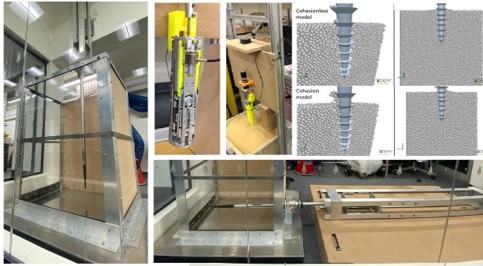 The research leads to
technologies for energy-optimised locomotion mechanisms and control. We pioneer
the R&D for bio-inspired Dual Reciprocating Drilling (DRD) technology -
also known as the ‘wasp drill’ - allowing deep drilling with flexible
deployment mechanism in low-gravity environments, and low-mass sampling tool
suitable for small space vehicles. (COSPAR Outstanding Paper Award 2016;
Finalist of IEEE/ASME's AIM Best Paper Award 2019; Exhibition at National
Science Museum 'Antenna' gallery). We also pionner or invented the innovative
surface Mobile Active Rover Chassis for Enhanced Locomotion (MARCEL), capable
of negotiating with loose soil and rugged terrains using minimal actuation.
Real-time testing and validation have been carried out using lab-based testbeds
or field trials, see demo videos at YouTube Playlists for planetary
subsurface applications and planetary
surface applications .
The research leads to
technologies for energy-optimised locomotion mechanisms and control. We pioneer
the R&D for bio-inspired Dual Reciprocating Drilling (DRD) technology -
also known as the ‘wasp drill’ - allowing deep drilling with flexible
deployment mechanism in low-gravity environments, and low-mass sampling tool
suitable for small space vehicles. (COSPAR Outstanding Paper Award 2016;
Finalist of IEEE/ASME's AIM Best Paper Award 2019; Exhibition at National
Science Museum 'Antenna' gallery). We also pionner or invented the innovative
surface Mobile Active Rover Chassis for Enhanced Locomotion (MARCEL), capable
of negotiating with loose soil and rugged terrains using minimal actuation.
Real-time testing and validation have been carried out using lab-based testbeds
or field trials, see demo videos at YouTube Playlists for planetary
subsurface applications and planetary
surface applications .
Major funded projects and
contributions to real-world missions: Kent Line Rental Scheme on 1m Lateral Cuts for Utility Sector;
ESA ExoMars mission’s sampling payload testing; ESA Lunar Polar Sample Return
(LPSR) mission’s L-GRASP payload testing; CNSA’s Chang’E3 mission terrain image
analytics; ESA’s ACT grant on Bionics and Space Systems; NPI/OHB grant on innovative
deep drilling; RAEng project on low-cost sampling; UKRI/UKSA funded FAIR-SPACE
project.
Major
journal papers and book chapters: see link
News & Media
Interviews
-
29 April 2026 由香港主導研發機器人將跟隨“嫦娥八號”探月球南極, 鳳凰衛視
-
29 April
2026 京沪港“航天智能”创新平台倡议在港启动, 中新社
-
29 April 2026 科大牽頭| 京滬港啟動太空智能深度科研協作, 經濟日報
-
18 December 2025 港科大:牽頭「嫦八」國際合作項目獲新進展 月面機械人全球首配「雙手」
「操作大腦」自主學習操控, 文匯報
-
28
November 2025 Hungry
for space, China Daily
-
1 August
2025, HK
universities see success in drive to attract more top talent from abroad,
The Straits Times.
-
11 June 2025 對話科學家|世界級太空機器人專家高揚:香港有望成爲東方航天的硅谷,
Hong Kong CNA
-
8 June 2025 專訪香港科大教授高揚:航天重要的是解決地球人問題, Hong Kong CNA
-
8 June 2025 香港科大教授高揚談航天商業化潛力無限, Hong Kong CNA
-
28 June 2024 Robotics for extreme environments, Electronic Specifier
-
2 December 2024 Trump may cancel Nasa's powerful SLS Moon rocket, The
Conversation
-
30 April 2024 Nasa's planned mission to retrieve rocks from Mars is in
trouble, The Conversation
-
6 March 2024 Spacesuits need a major upgrade for the next phase of
exploration, The Conversation
-
8 September 2023 Editor Spotlight: Yang Gao, Journal of Field Robotics,
Wiley
-
17 October 2022 Launching solar farms in space, Physics World
-
7 October 2022 Clearspace Secures A Major UK Contract to Help Clean Up Space,
Space South Central
-
27 June 2022 Light
People: Professor Yang Gao , Nature
-
27 April 2022 A LIFE AMONGST THE STARS , Higher Education Outreach
Network (HEON)
-
1 April 2022 Robotic arms, harpoons and spinning magnets: the galactic clean
space challenge , The National News
-
31 March 2022 第十四届 “中英创业大赛”: 萨里大学高扬教授带领的Ai4SPACE项目荣获冠军一等奖, 人民网
-
18 November 2021 Yang Gao and A Life Amongst the Stars , &ASIAN
-
31 August 2021 China’s Great
Science Leap, BBC Radio 4
-
1 July 2021 Elestial to collaborate with University of Surrey on orbital
platform concept study, SPRINT
-
10 Feb 2021 全球连线:海外专家瞩目 “天问一号” 造访火星, 新华社
-
7 December 2020 Surrey Professor Appointed Editor-in-Chief of Wiley’s Leading
Robotics Journal , UK-RAS Network
-
25 June 2020 UK-RAS Interview with Professor Yang Gao, STAR LAB, UK-RAS
Network
-
23 January 2020 Roundtable
TV Show for "ROBOTS: Time to think about laws?", TRT WORLD UK
-
11 November 2019 IROS.TV featuring STAR LAB, UK-RAS Network News
-
29 August 2019 Building a moon base is a huge task – here are the tiny
satellites that will pave the way , The Conversation
-
17 July 2019 To the moon and beyond 3: The new space race and what winning
it looks like, The Conversation
-
13 June 2019 特稿:中国开放空间站是
“伟大范例”,
新华社
-
3 January 2019 特稿:走,和国际伙伴一起探月去,
新华社
-
1 December 2018 NCUB State of the Relationship annual report , National
Centre for Universities & Business (NCUB)
-
28 December 2018 Artificial Intelligence: Advancing Space Exploration ,
Filling space
-
7 June 2018 ExpeRience: A space odyssey, Royal Institutions
-
5 October 2018 AI Boost for Opportunistic Science in Space Exploration - UK
STAR Lab Head, Sputniknews
-
30 April 2018 UK Space Roboticist being panelist at GREAT Festival of
Innovation , UK-RAS Network
-
9 December 2017 新闻: 刘延东副总理参观萨里大学承担的中英合作项目
-
9 June 2017 Nuclear decommissioning: sending the robots in , Power
Technology
-
25 July 2016 One giant leap for ROBOTS: Machines that walk, swim and climb
will replace humans on future space missions, Daily Mail
-
14 June 2016 UK robotics week, Engineering and Technology
-
14 March 2016 Innovation in Space , Royal Academy of Engineering
-
4 January 2016 Future Generation of Space Robots at UK's Own Space Station,
UK-RAS network
-
1 March 2015 Engineering for a successful nation, Royal Academy of
Engineering
-
1 January 2015 Feature film of University
of Surrey's Queen's Anniversary Prize in 1996 on space engineering.,
Queen's anniversary Prizes
-
01 September 2014 Testing the lunar surface , Royal Academy of Engineering
-Ingenia Magazine
-
October 2013 Space robotics
research: Past, present and future , IET.TV
-
August 2013 From
West Wittering to the moon or Mars! , ITV
-
February 2010 Innovative space drill among results of ESA’s
Networking/Partnering Initiative , ESA
-
06 June 2008 Britain's
Moon shot takes shape , BBC news
-
29 May 2008 A star-studded cast, Times Higher Education
-
24 April 2008 Today, Surrey. Tomorrow? The moon , Independent newspaper
-
15 March 2007 MoonLITE study , Dradio, Germany